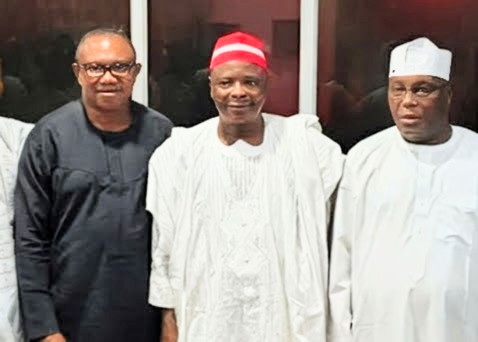
ABUJA – In a move bound to inject life into opposition politics in Nigeria ahead of 2027 general elections, former governor of Kano State, Rabiu Musa Kwankwaso, yesterday resigned from the New Nigeria Peoples Party (NNPP).
The action is believed to pave the way for him to formally join the African Democratic Congress (ADC) and team up with major opposition figures to contest the forthcoming elections.
Former Vice President Atiku Abubakar, who was the presidential candidate of the Peoples Democratic Party (PDP); former presidential candidate of the Labour Party, Peter Obi; former Senate President, David Mark and former governors of Osun and Rivers states, Rauf Aregbesola and Rotimi Amaechi are all in the ADC.
The development has raised the hope of the opposition who were almost giving up on the prospects of contesting the presidential elections in 2027.
Analysts posit that it is the lack of a similar alliance in 2023 that was responsible for the inability of the opposition figures to clinch the presidency, when Atiku, who flew the flag of the Peoples Democratic Party (PDP), polled 6,984,520 votes; Obi of the Labour Party, 6,101,533 votes and Kwankwaso of the NNPP, 1,496,687 votes.

Analysts contend that if the three had stood together under one platform and their votes combined, they could have made the then candidate of the ruling party, Bola Ahmed Tinubu, who scored 8,794,726 to lose the election.
It is not clear if it is such permutations that have brought the three former presidential candidates under one banner this time around.

For almost three years, however, Nigeria has witnessed an unprecedented sweeping of the nucleus of all major and minor parties in the country by the ruling All Progressives Congress, APC, leading to fears that the country may evolve into a one-party state.
From serving and former governors, key opposition figures in the National Assembly to influential politicians across the country, the APC has been attracting opposition elements in their numbers.

For the first time since 1999, Lagos, Kano, Kaduna and Rivers all have governors from the ruling party.
Added to that, the states with the larger resources, Lagos, Rivers, Akwa Ibom, and Delta are all under the APC.
The one that was yet to be captured entirely out of the states whose votes could alter equations was Kano, due to the inability of the ruling party to woo Kwankwaso to its fold.
Kwankwaso is seen as the main figure behind Kano voting for the NNPP in 2023. Even with the defection of Governor Abba Kabir Yusuf, politicals say all is not yet Uhuru for the ruling party as far as Kano is concerned.
reflects a broader strategic calculation that prioritizes coalition-building over political isolation. The ADC has, in recent months, emerged as a rallying platform for opposition figures seeking to challenge the dominance of the ruling APC.
Its growing appeal lies in its perceived openness to alliances and its potential to serve as a unifying force among fragmented opposition blocs.
Prominent figures such as Atiku Abubakar and Rotimi Amaechi are already associated with this evolving coalition, lending it both credibility and national reach.
The move offers Kwankwaso multiple strategic advantages. It elevates him from the confines of a relatively small party into a broader political arena, enhances his negotiating power within a coalition framework, and positions him as a key stakeholder in any future electoral arrangement.
Perhaps most importantly, it allows him to remain relevant in a political environment where alliances often determine outcomes.
“Kwankwaso willing to support whoever emerges candidate”
According to the spokesperson II of the Kwankwasiyya Movement, Mansur Kurugu, the ideological and strategic thinking behind their leader’s move is national interest and not personal candidacy ambition.
He said the decision to join the ADC is anchored on what he described as the “Save Nigeria Project”, a broad-based initiative aimed at addressing systemic challenges facing the country.
“The focus and the most important reason why we joined ADC is to make sure the government gets into what we call the Save Nigeria Project. This is a bigger project that is actually bigger than any individual’s interest,” he said.
Kurugu emphasized that the coalition is designed to provide Nigerians with a credible alternative capable of confronting the current administration and offering a different governance approach.
“The whole idea is to bring and give Nigerians an option…to create one strong opposition that can challenge the government,” he added.
On the question of whether Kwankwaso entered into any prior arrangements with ADC leaders, Kurugu acknowledged the realities of political negotiation while downplaying its centrality.
“We would never expect a politician of his calibre to join a party without a proper arrangement or framework… but that is not the primary reason,” he said.
Perhaps most revealing was his response to speculation about Kwankwaso’s ambition for the 2027 elections. Rather than assert a fixed position, Kurugu presented a flexible approach rooted in collective decision-making.
On the fears of their cohabitation under one umbrella, Kurugu said the fact that in 2019, the trio of Atiku, Obi and Kwankwaso worked under the same platform of PDP together is enough to prove that they can as well do so now in the interest of the country.
“If the calculation and arrangement require him to go for president, he will. If it requires him to serve as vice president, he will also serve.”
Kwankwaso’s meeting with Atiku, Aregbesola, others
Kwankwaso’s recent engagement with former Vice President Atiku Abubakar marks a significant development in the evolving opposition landscape. Both men share a long political history, having previously operated within the same party before parting ways.
Their renewed interaction suggests a willingness to set aside past rivalries in pursuit of a common objective.
Discussions between the two camps have reportedly focused on building a unified opposition front, negotiating power-sharing arrangements, and avoiding the fragmentation that has historically weakened opposition efforts in Nigeria.
He has also held strategic consultations with former Osun State governor, Rauf Aregbesola, a key figure within the ADC’s evolving structure.
Aregbesola’s influence in the South-West and his reputation for grassroots mobilization make him a critical player in the coalition’s expansion strategy.
Their discussions reportedly centered on strengthening party structures, ensuring internal cohesion, and developing mechanisms for managing competing ambitions within the party.