Nigeria produces a particular kind of man once in a generation. He is the kind whose biography reads like a long argument that history has been quietly assembling on his behalf, patient and deliberate, brick by brick, year by year, until the structure becomes undeniable. His names, laid side by side, constitute a prophecy. Gboyega. Yoruba. A declaration so full of settled dignity it requires no crowd to ratify it: the crown vindicates itself. Nasir. Arabic. Islamic.
A covenant embedded in faith, the name of a helper, a protector, the one who arrives when arrival costs something. Isiaka. A name carrying the solemnity of scripture and the deep warmth of a lineage stretching back into the red earth of Yewa country. Say all three together and you have not merely introduced a man. You have announced a purpose.
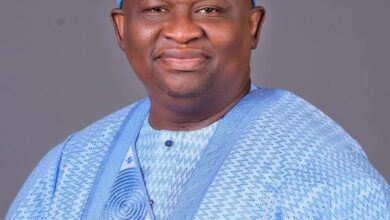
Gboyega Nasir Isiaka, known widely as GNI, was born on this day, the seventeenth of February, 1962, in Imeko, a town in Imeko-Afon Local Government, in the far reaches of Ogun West. That geography was not incidental. It was formative. And to understand the man GNI has become, one must first understand the ground from which he grew.
Imeko carries itself quietly. It sits at Nigeria’s frontier with the Republic of Benin, a place where two countries share a horizon, and where the people have, for centuries, understood that identity is something you carry within you rather than borrow from your surroundings. The Yewa people have a particular character: humble without arrogance, resilient without rigidity, capable of a patience that outsiders sometimes mistake for passivity, until the moment when that patience reveals itself as strategy. GNI is, in this sense, the fullest expression of where he came from. Imeko shaped in him a foundational self-reliance, the kind that comes only from growing up in a place that taught its sons and daughters to build their own tables rather than wait for a seat at someone else’s. He has carried that quiet strength into every room he has ever entered, in Abuja, in Abeokuta, and everywhere the work has taken him.
His three names compound this geography in ways that go beyond the personal. A man who grows up carrying Yoruba culture in one hand and Islamic spirituality in the other does not develop a divided self. He develops a wider one. He learns to hold together what others assume must fall apart, and he learns that synthesis is a higher discipline than purity, that the capacity to contain multitudes without fracturing is both a gift and a preparation for something larger than the self. It is no accident, then, that Yewaland itself formalised this truth in the title it bestowed upon him: Seriki Adinni of Yewaland, the Leader of the Faith among his own people. The title is extraordinary precisely because of what it brings together. Seriki, rooted in the deep soil of Yoruba chieftaincy tradition, and Adinni, drawn from the spiritual lexicon of Islam, conferred by a community that looked at this man and saw, in a single person, the fullest expression of both inheritances.

Ogun State itself is a land of extraordinary layering. Ancient kingdoms and modern industry coexist here. Intellectual tradition and commercial ambition press against each other. The frenetic gravitational pull of Lagos strains persistently against a stubbornly distinct identity that has always refused to be absorbed. To lead such a state requires a man who refuses to simplify it, one who can hold its full complexity without flinching. GNI has studied Ogun State with the devotion of a scholar and the patience of a son. He has loved it with the exacting love of someone who knows a thing’s full complexity and chooses it anyway, and he has spent decades positioning himself as the leader capable of holding all of it together.
That depth of understanding is visible in his legislative work. In the National Assembly, where GNI serves as the representative of Yewa North/Imeko-Afon Federal Constituency, his chairmanship of the House Committee on National Planning and Economic Development is not a biographical footnote. It is a revelation of character. He has brought to that assignment an insistence that national planning be accountable planning, that economic development be human development, that the work of the committee serve the constituents who will live with its consequences rather than the constituencies of power that would rather the work looked good in reports than felt good in lives. In a legislative culture where committee chairmanships are frequently treated as platforms for personal advancement, GNI has treated his as a public trust. The distinction matters enormously, and the people have noticed.

Political integrity is rare anywhere on earth. In Nigeria, it functions as an endangered species, celebrated in oratory, undermined in practice, and treated with active suspicion when it actually appears in a living person. GNI has carried his through years of political weather that would have eroded a less anchored man. He has resisted, repeatedly, the gravitational pull toward convenience that swallows so many promising careers, and this resistance has never been a posture. It has been a practice. It is the signature of a man who thinks in decades rather than election cycles, one who has studied the history of Ogun State carefully enough to understand that the people’s memory outlasts any administration, and that what a leader does when doing the right thing is costly is precisely what the people will ultimately remember.
There is a particular courage in refusing to become what the moment rewards when what the moment rewards is wrong. GNI has exercised that courage at personal cost, and he has done so with a quietness that speaks louder than theatrics. A man who abandons his convictions for comfort purchases his ease at the cost of his usefulness, and a leader without usefulness is an expensive luxury his people cannot afford. GNI has understood this with a clarity that no political coaching could have produced. It is the understanding of a man who took seriously the meaning of his own name.

His political journey has carried scars. There have been seasons of setback, moments when the machinery of politics ground directly against his aspirations, when the weight of entrenched interests pressed hard on a man too principled to pay what was being asked of him. He absorbed those seasons without bitterness, which is itself an advanced form of wisdom. GNI grew where others shrank. The setbacks refined him rather than defining him, and this is perhaps the most telling thing about his character: that adversity has consistently produced in him more clarity, more resolve, and more grace.
The observable pattern across six decades of life and multiple decades of public engagement reveals a man whose orientation toward service has survived a level of testing that would have redirected a lesser conviction long ago. He has had opportunities to leverage his political capital in ways that would have enriched him personally at the direct expense of what he had to offer his people. He declined those opportunities not once, as a statement, but repeatedly, as a habit. He has had occasions where walking away from principle would have opened doors that staying on principle kept firmly closed. He stayed. This is worth stating plainly and without ornamentation, because the political climate does so little to reward it and so much to punish it. GNI has made that choice with a consistency that reads now as character rather than calculation, and there is a crucial difference between the two. Calculated integrity is a temporary performance. Character is a permanent condition.
What makes this all the more remarkable is how it has expressed itself at the ground level. His investment in people, in their education, their economic agency, their dignity as human beings rather than as voters to be mobilised, has been a through-line across his entire public life. Long before elections demanded his presence in communities, his presence was already there, offering something beyond a promise and a photograph. The people of Yewaland know this. They have experienced it directly. And it is this kind of knowing, the knowing that comes from lived experience rather than received narrative, that forms the bedrock of genuine political trust.
A birthday is, among other things, an invitation to honest inventory, and it is worth taking one here.
GNI carries into his sixty-fourth year a knowledge of Ogun State so granular, so deeply earned through years of actual presence and genuine attention, that it constitutes a civic responsibility in its own right. He is the kind of man who can read his people’s silences, who understands what they withhold as clearly as he hears what they say, because he has been present long enough and consistently enough to understand the full grammar of their lives. He carries a vision of what the Gateway State could yet become, a governance culture grounded in human dignity, a democratic promise that has been long deferred and has never expired. And he carries something that no amount of money or strategy can manufacture: the accumulated trust of relationships built over years across every dimension of Ogun State’s public life, political, economic, civil, religious and cultural. These things do not simply add up. They compound. They become wisdom. And wisdom, the kind forged through consequence and failure and sustained reflection, is precisely what the current moment in Ogun State and in Nigerian democracy most urgently requires.
Sixty-four years have passed since that birth in Imeko. They have not diminished him. They have concentrated him, the way prolonged heat concentrates ore, burning away everything superfluous until what remains is pure, purposeful and ready. There is a tide in the affairs of states, as in the affairs of men. It arrives quietly and without fanfare, and those who recognise it are those who have been watching long enough, preparing seriously enough, so that when the tide comes in, they find themselves already standing on the right ground.
GNI has been standing on the right ground for a long time.
Ogun State, with its extraordinary talent, its historic institutions, its industrious people and its immense unrealised potential, deserves leadership that matches its complexity rather than flattening it for the sake of convenience. GNI has spent decades becoming that match, through labour and through loss, through the slow and serious accumulation of genuine understanding. He has become, in the fullest sense, a man equal to the weight of the assignment his people represent. His character has been tested. His love for his state has been demonstrated. His moment has arrived with the particular clarity that comes only when a man and his time finally find each other, and both are ready.
For that love, for that labour, for decades of consistency in service to something larger than himself, Ogun State owes GNI a recognition that is, at last, arriving.
Happy birthday, sir. Sixty-four looks, on you, like a beginning.
Femi Peters, a public affairs analyst, writes from Abeokuta, Ogun State capital.