Certificate Scandal: Kemi Adeosun Breaks Silence Eight Years After, Says Resignation Not Admittance Of Wrongdoing”
•Says powerful enemies used NYSC certificate row to get rid of her


ABUJA – Former Minister of Finance, Mrs Kemi Adeosun, has given her most detailed account of the circumstances that led to her resignation from President Muhammadu Buhari’s cabinet in September 2018.
She said the decision was taken to safeguard the integrity of the Office of the Minister of Finance and to allow her to defend her name through the courts.
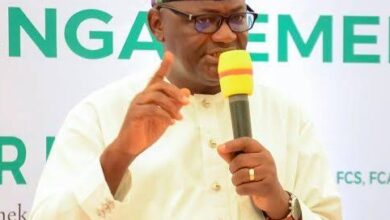
Adeosun spoke on Friday during an appearance on Channels Television’s Inside Sources with Laolu Akande, where she addressed the controversy surrounding her exemption from the National Youth Service Corps and the political consequences that followed.
According to her, stepping aside was a conscious choice rooted in principle rather than an acknowledgement of fault.
She explained that remaining in office while pursuing legal action against the government would have placed both her and the institution she represented in an untenable position.

“People kept asking why did I resign? That no one resigns as minister of finance as I did,” she said. “I still think it was the right thing for me to do.”
She described the moment as one that demanded clarity of values, insisting that the responsibilities of the finance portfolio could not be reconciled with the personal task of clearing her name. “My resignation is a matter of principle and not an admission of wrongdoing. It was a step to protect the Office of the Minister of Finance and defend my reputation,” Adeosun said. “I can’t be attending local and international meetings as minister of finance, and also appearing in a court in a case of integrity and reputation.”

The former minister added that the idea of suing the government while serving as a senior cabinet member was inappropriate. “I knew I would need to go to court to clear my name, and doing so was not compatible with being Minister of Finance representing Nigeria at the highest level,” she said.
Adeosun recalled personally informing President Buhari of her decision. “I went to see Mr President, and I said, ‘Mr. President, I need to go. I need to go to court because I have to clear my name,” she recounted. According to her, the President agreed with the course of action and supported her decision to seek legal redress. “These names are leased from our children and our grandchildren. You don’t destroy your name because you want to stay as minister,” she added.

In July 2021, the Federal High Court in Abuja ruled that Adeosun was ineligible to participate in the NYSC scheme. The court held that under the 1979 Constitution, which was in force at the time of her graduation, she was not a Nigerian citizen either when she graduated or when she turned 30, the age threshold for the scheme.
Adeosun graduated from the University of East London in 1989 at the age of 22. Justice Taiwo Taiwo, who presided over the case, ruled that the constitution did not require her to present an NYSC certificate or any academic certificate as a condition for ministerial appointment. The court further held that her appointment as Minister of Finance was neither illegal nor unconstitutional despite the absence of an NYSC certificate.
The suit, filed in March 2021 by the law firm of Chief Wole Olanipekun (SAN), on her behalf, also addressed the issue of citizenship. The court ruled that because the 1979 Constitution did not recognise dual citizenship, Adeosun could not be considered eligible for the NYSC scheme at the time. By the time Nigeria’s laws permitted her citizenship status to revert, the court noted, she was already well above the age limit for participation.
Beyond the legal and political controversy, Adeosun used the interview to reflect on policy debates, particularly the issue of fuel subsidy removal and the current tax reforms. She maintained that the policy of fuel subsidy was unsustainable and widely understood as such within the government.
“There was no minister who did not know that subsidy was killing us,” she said, pointing to the distortions created by subsidised fuel prices and Nigeria’s porous borders. “We had consumption figures of about 65 million litres per day with only about 10 million cars. It was not possible.”
She argued that subsidy payments drained resources that could have been deployed for development. “Money spent on subsidy is money you can spend on roads, education or health,” Adeosun said, while cautioning that reforms must be accompanied by long-term solutions to cushion citizens. “You need structural solutions, not just palliatives, to help people absorb policy changes.”
On tax reform, Adeosun spoke candidly about the resistance finance ministers often face. “When you’re Minister of Finance, the word ‘no’ becomes your watchword,” she said. “If your finance minister is loved by everybody, they’re probably not doing much of a job.”
She defended initiatives such as the Voluntary Assets and Income Declaration Scheme, which sought to bring wealthy individuals and large corporations into the tax net, and praised the current administration for advancing data harmonisation across government agencies.
“I was excited when I saw moves to harmonise data,” she said. “We’ve had TIN, NIN, BVN—too many numbers. Once you harmonise data, it becomes very difficult to hide.”
According to her, integrated data systems, combined with technology, make it easier to identify those benefiting from public resources without meeting their tax obligations. “Once you have data, and with AI, you can see very quickly who is not playing the game fairly,” she said.
Adeosun also touched on insecurity, describing it as a deeply rooted problem that requires sustained effort. She recounted a traumatic personal experience during her tenure, when her home was invaded, and she was robbed at knifepoint. “It was extremely scary,” she said. “I never slept in that house again.”
Despite such experiences, she expressed cautious optimism about current efforts to address the crisis. “Insecurity didn’t start overnight, and it won’t end overnight,” she said. “But what matters is that there is now a clear will to tackle it.”
Away from public office, Adeosun has focused on social impact through DashMe Stores, a charity initiative she founded in 2021. She revealed that the organisation has raised more than ₦500m to support vulnerable people and orphanages across the country.
“We started in 2021 with one store. We’re now on our fifth store and expanding,” she said. DashMe currently operates one outlet in Abuja and three in Lagos, with a fifth scheduled to open in Abeokuta next month. Plans are also underway for expansion to Ibadan, Port Harcourt, Kano and the Federal Capital Territory.
She explained that the model relies on local partnerships in areas where her team cannot be physically present. “In each of those places, we rely on partners to work with us, and we’re seeing no shortage of people willing to get involved. They like what we’re doing. They like helping,” she said.
Adeosun stressed that DashMe operates strictly as a not-for-profit venture. “Cumulatively, we’ve raised over ₦500m from our stores and partnerships, and that is exactly how much has gone out,” she said. “I don’t get paid. The only people who are paid are the shop staff. Everything else goes back into helping people.”
According to her, the organisation has built about four orphanages from scratch, refurbished several others and taken over abandoned projects, including one that had been left unfinished for more than four decades. “Children’s lives are unstable enough without landlords issuing quit notices,” she said. “They deserve to be in their own homes.”
She also spoke of setbacks, including the vandalisation of an orphanage under construction shortly before Christmas. “It was painful, especially because it was pointless,” she said. “But we’ll soldier on and complete the project.”
On poverty, Adeosun argued that the challenge is global rather than uniquely Nigerian. “Every country has a metric for classifying poverty,” she said, noting that large populations naturally produce high absolute numbers. “Because of our numbers, there will always be a core of poverty that remains.”
She insisted that the true measure of progress lies in social mobility. “What matters is whether people are able to move from poverty into the middle or lower-middle class,” Adeosun said. “The worst kind of poverty is generational poverty, where generation after generation remains poor with no social mobility.”
Education and enterprise, she said, remain the fastest routes out of deprivation, often creating ripple effects as individuals support extended families and communities.
Adeosun concluded with a broader reflection on citizenship and governance, arguing that societal progress often begins outside government. “Government never starts anything. People start, and the government takes it over,” she said, recalling how many social institutions in other countries began as citizen-led initiatives.
Recounting an experience where DashMe offered to refurbish a state-run orphanage, only for officials to promise action themselves, she added, “It’s the people that lead the government. One of our challenges in Nigeria is that we expect the government to lead the people. It should be the other way around.”