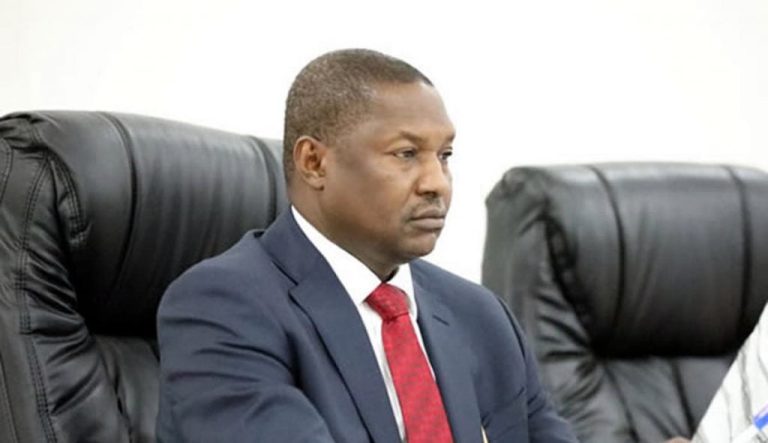
FCT – Federal High Court sitting in Abuja, on Tuesday, ordered the remand of the former Attorney-General of the Federation and Minister of Justice, Abubakar Malami (SAN), at the Kuje Correctional Centre pending the hearing and determination of his bail application.
Trial judge, Justice Emeka Nwite, also ordered the remand of Malami’s son, Abubakar Malami, and one of his wives Bashir Asabe, who are all his co-defendants.
Justice Nwite issued the order after hearing arguments from the defence team led by Joseph Daudu (SAN) and the prosecution counsel, Ekele Iheneacho (SAN).
Malami, his so and wife are facing a 16-count money laundering charge preferred against them by the Economic and Financial Crimes Commission.
The EFCC has accused the defendants of conspiring at various times to conceal, retain and disguise the proceeds of unlawful activities running into several billions of naira.

The charge states that the alleged offences span several years and include the use of companies and bank accounts to launder funds, the retention of cash as collateral for loans, and the acquisition of high-value properties in Abuja, Kano and other locations.
The anti-graft agency further alleges that some of the offences were committed while Malami was serving as Attorney-General of the Federation, in breach of the Money Laundering (Prohibition) Act 2011, as amended, and the Money Laundering (Prevention and Prohibition) Act 2022.

Malami, a Senior Advocate of Nigeria, the court ruled, is to remain in Kuje prison till January 2, 2026, when his written bail application will be argued by his legal team.
The oral bail request argued on Tuesday by Malami’s lead counsel, Joseph Daudu SAN, was turned down by Justice Nwite on the ground that it would amount to an ambush on the side of the EFCC that put Malami on trial.

Justice Nwite said that since a written bail application has been filed and filed on EFCC, the interest of justice would be met if EFCC is allowed to respond to the application as required by law.