

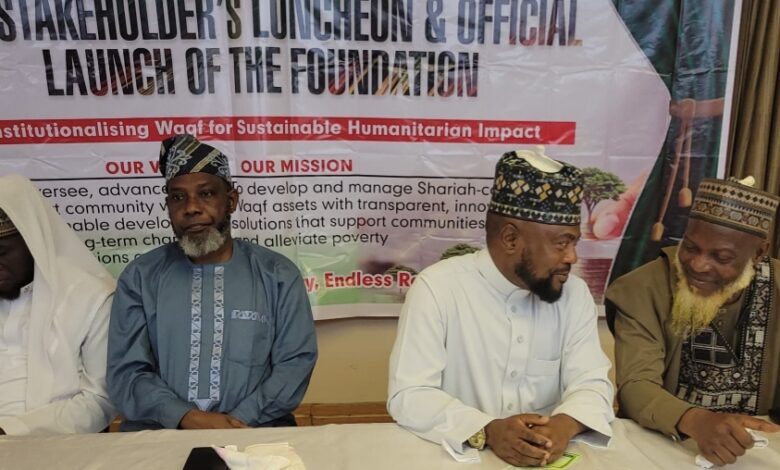
ABEOKUTA -The Al-Abraar Waqf Foundation has been officially launched in Ogun State, with Islamic scholars and foundation officials calling for greater support for sustainable charitable endowments capable of benefiting communities across generations.
The launch, held on Sunday at Park Inn, Abeokuta, the state capital, brought together Islamic scholars and other stakeholders to promote Waqf, an Islamic endowment system designed to support education, healthcare, poverty alleviation and community development through sustainable funding.
In his welcome address, the Chairman of the Board of Trustees, Engr. Jamiu Keshinro, described Waqf as one of the most enduring institutions in Islamic history, noting that it provides a means of sustaining charitable benefits beyond the lifetime of donors.
“Waqf is one of the most powerful and enduring institutions in Islamic history. It is a form of ongoing and everlasting charity that continues through generations,” Keshinro said.
He explained that the foundation was established to develop, manage and advance Waqf assets, with the returns channelled towards community welfare and long-term development.

“Through a Waqf fund, the asset is reserved and its returns continuously benefit education, healthcare, poverty alleviation and community development,” he added.
Keshinro said the Board of Trustees recognised the responsibility entrusted to it and remained committed to preserving the foundation’s assets, upholding its guiding principles and ensuring that its activities generated lasting benefits.

He called on prospective donors, partners and other stakeholders to support the initiative, stressing that collective commitment would be essential to sustaining its mission.
Delivering the guest lecture, Professor Abdulmajeed AbduRazaq Alaro, a renowned scholar of Islamic law, jurisprudence and Islamic finance, described Waqf as a means through which individuals could dedicate their resources to charitable causes whose benefits would continue beyond their lifetime.

“If anybody wants his or her resources to continue to be of benefit to him or her even when he or she is no more, then your gateway is to have an endowment,” Alaro said.
He explained that Waqf is closely associated with Sadaqah Jariyah, or continuous charity, which offers Muslims an opportunity to sustain charitable contributions beyond their lifetime.
“Continuous charity or Sadaqatul Jariyah is another name for what we call Waqf. Waqf is what will be named as endowed, while the benefit is what goes to the beneficiaries,” he said.
The scholar cited a hadith of Prophet Muhammad on three deeds whose rewards continue after a person’s death, including continuous charity, urging Muslims to embrace endowments as a means of securing lasting benefits for society.
Alaro encouraged prospective donors to contribute according to their means, noting that landed properties, real estate and other suitable assets could be dedicated to charitable endowments.
He identified donors, managers and beneficiaries as key stakeholders in the success of Waqf, emphasising that effective management and responsible stewardship were essential to preserving donated assets and ensuring that their proceeds were applied to their intended purposes.
The professor also urged the foundation’s managers to embrace transparency, proper financial reporting and regular auditing to strengthen public confidence and ensure accountability in the management of the endowment.
Speaking on the foundation’s strategic policy, the Secretary of the Board, Alhaji Sulaiman Fasasi, said trust and accountability were fundamental principles guiding its operations.
He described every donation entrusted to the foundation as a sacred responsibility, adding that its governance and operational structures had been designed to promote transparency, accountability and compliance with Islamic principles.
Fasasi disclosed that the initiative to institutionalise Waqf in Abeokuta followed a challenge issued by Professor Alaro during a Waqf lecture in 2025, when he called on stakeholders to move beyond theoretical discussions and translate the concept into practical action.
According to him, the foundation’s governance structure comprises the Board of Trustees, the Executive Council and the Sharia Advisory Council, headed by Professor Alaro, with clearly defined responsibilities to support effective administration and ensure adherence to relevant Islamic principles.
He called on stakeholders in Ogun State and beyond to support the initiative, stressing that the success of the foundation would depend on collective commitment to building a sustainable endowment institution.
“Let us invest in a legacy that does not end with our lifetime. By establishing and supporting Waqf, we can contribute to enduring acts of charity whose benefits continue to flow, by Allah’s mercy, even after death,” Fasasi said.
He added that the foundation’s operations would be guided by Islamic principles, with the Sharia Advisory Council providing oversight and guidance on compliance with relevant religious requirements.
The foundation’s vision is to advance Waqf assets for community welfare, sustainable development and long-term charitable impact, while its mission includes developing and managing Shariah-compliant endowments through transparent and innovative approaches to community support and poverty alleviation.
Its core values include integrity, transparency, stewardship, sustainability and inclusivity, with particular emphasis on extending assistance to underprivileged members of society.
The foundation said its success would ultimately be measured not by the scale of its launch, but by the durability of the benefits it creates and the number of lives transformed through its charitable interventions.


