
ABEOKUTA – A University Don, Prof. Christianah Olakitan Ijagbemi of the Federal University of Akure (FUTA), Ondo State has enjoined engineering professionals and academics to imbibe digital skills in repositioning engineering practice for a sustainable future.
Prof. Ijagbemi gave the charge on Friday in Abeokuta at the annual lecture and induction of corporate members and inauguration of new executive members of the Nigerian Society of Engineers (NSE), Abeokuta branch.
Delivering a paper titled: “Repositioning Nigeria’s Engineering Education, Digital Practice and Talent for a sustainable future”, Prof. Ijagbemi said digital application into engineering practice would help to nurture talent and meet the demands of a rapidly changing world.
According to her, engineers should improve their technical capacity by detecting future problems and proffer solutions through digital application and Artificial intelligence.

She maintained that, many professionals particularly academia are still dwelling in the past by teaching their mentees and engineering students obsolete curriculum in schools which inadvertently affect their output performance when they get to the field.
She, however, called for engineering rejigging through education, practice and expertise.

She blamed the low productivity output by young engineers on the lack of exposure and required tools in practical training by scholars in the higher institutions.
She called for collaboration between higher institutions and the industry to provide solutions to the problems facing the profession, stressing the need for a research based curriculum among faculties of engineering in the higher institutions.

“I want to say that, the issue is actually not having the required tools to train young engineers, students in engineering faculties. With the industry complaints, we also want to see them collaborating in working hand-in-hand in tandem with the university system.
“I want to clamour for a synergy between the industry and the institutions in bringing their problems to the institutions and let the problems become research based. We now need the government to support the policy and encourage industries to do such.
“Many professionals are still dwelling in the past. They teach students an obsolete curriculum in schools which is responsible for the industry complaints because most of our young engineers are not meeting the demands of the industry.
“There’s nothing wrong for a lecturer in the university go for sabbatical in the industry instead of doing the sabbatical in another institution. He can do that in an industry related to his or her discipline and by that they would be exposed to the current challenges and tools in the industry. And the experience will be brought back to the classrooms for the students so that they can have knowledge of the field and the class theory.
“We also need the support of the government to provide facilities in our institutions that can also aid in the teaching of AI engineering or digital engineering so that our graduates can compete favourably globally.”
Prof. Ijagbemi, therefore, urged Nigerian higher institutions to introduce programming, data analysis, and digital modelling early to integrate digital tools into core engineering subjects.
She further recommended that final-year students projects should demonstrate digital workflows, saying digital fluency should be treated as professional literacy, not specialization.
She called for redesign SIWES programme with clear learning outcomes and assessment, by expanding project-based learning with industry participation and encourage co-teaching models involving practitioners.
She buttressed that universities should not simulate practice, but interface with it.
In his submission, the commissioner for forestry in Ogun State, Engr. Taiwo Oludotun, congratulated the new inductees, calling for participation of women engineers into the profession.
He charged the inductees to see their inauguration as a professional calling, and a wake up call to help the profession in terms of practicing.
He blamed the crass for immediate employment after graduation on the low productivity output by young Nigerian engineering graduates.
Oludotun charged engineering undergraduates to delve into practical skills before seeking permanent employment for them to be self-fulfilling.
“I appreciate what the guest speaker said, because you find out these days that most people, as soon as they’re out of school, their course of studies is basically theory, and there’s no practical experience. And now the best thing is for everyone, is that even after their studies in their schools, they must make sure they go into practicing this profession. And the fact is, as an engineering professional, all they want is just to get employed in this wise, they forget that they need to practice their profession, because their contribution to society and to the profession alone cannot be quantified.
“So in this sense, I will just say, whenever they find the opportunity to practice the line of their discipline is very important. It makes them self employed and self fulfilling. So I would just want to encourage the young ones and the inductees that they need to practice this profession.”
Earlier, in his welcome address, the Chairman, Nigerian Society of Engineers (NSE), Abeokuta branch, Engr. Olumayowa Idowu the inauguration of the new inductees and annual lecture was a celebration of professional excellence and renewal of commitment to engineering service.
Engr. Idowu noted that the induction of new corporate members symbolizes the growth and future strength of the engineering profession.
According to him, the inauguration of the new executives reflects trust, responsibility and the ongoing evolution of leadership.
He said the annual lecture reminded that engineering must continually adapt to national and global realities.
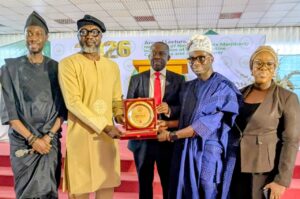
Meanwhile, 52 new members were inducted into the NSE Abeokuta branch, while the event was heralded with a presentation of Awards.