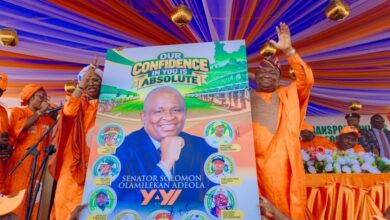
ABEOKUTA – A former Acting Executive Chairman of the Federal Character Commission (FCC) and member representing Ogun State in the Commission, Kayode Oladele, has reiterated that any alliance between former Labour Party candidate, Peter Obi, and former Kano State Governor, Rabiu Musa Kwankwaso, ahead of the 2027 general elections, cannot stop second term re-election of President Bola Tinubu and the ruling APC.
Oladele said although conversations around an Obi Kwankwaso alliance may excite sections of the opposition, the proposed partnership lacks the political structure, national spread, and organisational strength required to defeat an incumbent government with deep roots across the federation.
In a statement, Oladele argued that Nigerian presidential politics goes beyond regional enthusiasm, stressing that national electoral victory is built on tested structures, broad alliances, grassroots coordination and institutional depth.
He noted that while Obi recorded notable support among young and urban voters in the 2023 presidential election and Kwankwaso maintained influence in Kano and parts of the North through the Kwankwasiyya movement, both men remain largely dominant within separate political constituencies whose merger may not automatically produce national success.
According to him, “Politics at the national level requires more than regional appeal. It demands a broad coalition that cuts across geography, ethnicity, and other important considerations . There is little evidence for now that the support bases of Obi and Kwankwaso are naturally compatible in a way that can produce a winning national alternative.”

Oladele said Nigeria’s political history has repeatedly shown that opposition alliances often struggle when they are driven more by personal interests and convenience than by shared ideological conviction.
He recalled that the inability of major opposition forces to unite ahead of the 2023 elections contributed significantly to the APC’s victory, adding that simply combining two strong personalities without resolving structural weaknesses may amount to “merging two incomplete political platforms.”

The former lawmaker maintained that the APC remains the most formidable political force in the country because of its entrenched national presence and extensive grassroots network.
He said the ruling party’s control of over 30 states through serving governors gives it a major electoral edge that would be difficult for any opposition coalition to neutralise.

“Governors remain central to political mobilisation, grassroots coordination, voter turnout, and party discipline. With over thirty governors and an established political network nationwide, APC’s advantage going into 2027 is substantial,” he said.
Oladele also credited Tinubu’s long standing reputation as a strategist and coalition builder as a critical factor in the party’s continued strength.
He noted that Tinubu’s political experience, particularly in forging alliances that birthed the APC, places him in a strong position as the country gradually moves towards another election cycle.
Defending the administration’s economic reforms, Oladele described the removal of fuel subsidy and the restructuring of the foreign exchange system as bold but necessary measures aimed at repositioning the country’s long term economic future.
He acknowledged the economic difficulties associated with the policy reforms but insisted that difficult reforms often come with temporary hardship before long term benefits become visible.
He said by 2027, Nigerians would be better placed to assess the impact of the administration’s policies, adding that if the reforms begin to produce measurable gains, the case for continuity would become stronger.
“Governance is not always about immediate comfort. Sometimes it requires difficult but necessary decisions that secure future stability. If these reforms begin to yield results, continuity will become a compelling argument,” he stated.
Oladele further argued that the opposition has yet to present a sufficiently coherent national alternative capable of matching the complexity of Nigeria’s governance and economic realities.
He said criticism of government policies, while legitimate, must be backed by practical and detailed solutions.
“Nigerians are not merely looking for change. They are looking for workable change. It is not enough to criticise. There must be credible alternatives,” he added.
He also warned that an Obi Kwankwaso alliance could face internal contradictions, including questions of leadership balance, voter transferability, and regional perception.
According to him, supporters do not always follow political leaders mechanically, and alliances that appear attractive on paper can quickly unravel in practice.
Oladele said as political permutations intensify ahead of 2027, Nigerians are likely to prioritise stability, tested governance, and credible national organisation over fragile coalitions built primarily on electoral desperation.
He concluded that while speculation over an Obi Kwankwaso ticket may continue, the political reality currently favours the APC.
“Interest alone does not win elections. Social media enthusiasm does not replace structure. What wins elections is organisation, coherence, and national capacity, and on those fronts, APC remains clearly ahead,” he said.