The air in Abeokuta did not merely carry the heat of a tropical afternoon; it carried the resonance of a century’s worth of history, vibrating with the sudden, sharp crack of talking drums. When Senator Solomon Olamilekan Adeola – the man the world knows as Yayi – stepped into the ancient precincts of Kemta and the hallowed shadows of the Ake Palace, the atmosphere shifted. This was no longer a political consultation. It was a cultural coronation, a homecoming staged in the deep, mystical indigo of adire and the ancestral breath of benedictions that seemed to rise from the very stones of Olumo Rock.
At Kemta, the drums spoke with the tongues of long-dead ancestors. Yayi stood in the center of this whirlwind, draped in the deep blue indigo agbada, his matching cap hosting his designer insignia “Y.” The soul of adire resides in the vats of Kemta, where Madam Jojolola, the second Iyalode of Egba, invented the craft. His choice of attire was a silent, powerful manifesto – a declaration of belonging that transcended the ballot box.
When he spoke, his voice carried the weight of a man reclaiming a stolen birthright. Addressing the “stranger” narrative favoured by his detractors, Yayi reached into the archives of his DNA. “Abibat Olasumbo Akinola is my mother,” he declared with an emotional gravity that silenced the courtyard. “Kabiyesi, I am your son. My mother is from Egbaland. I am no stranger to this soil; I have identified with Egbaland for over 20 years directly. Abeokuta is my maternal home, and I hold this town very dear to my heart.”
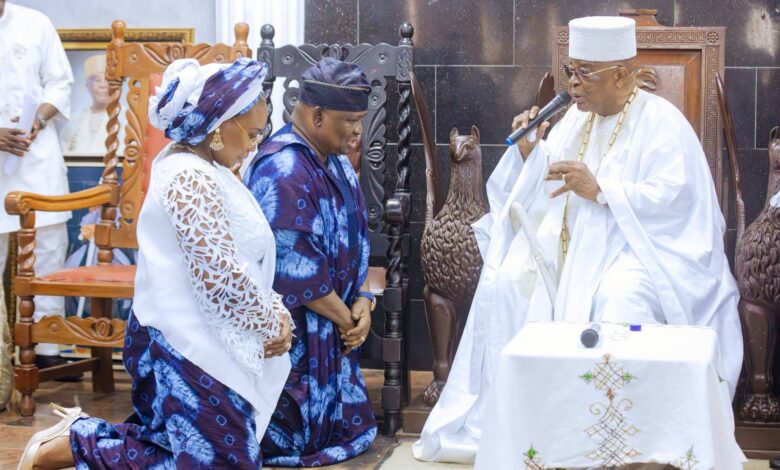
The ritual deepened as the procession moved toward the Ake Palace, where the Alake and Paramount Ruler of Egbaland, Oba Adedotun Aremu Gbadebo, waited to perform the iwure – a prayer that exceeded mere blessing; it was a pragmatic positioning of a leader within the continuum of Egba greatness.
After the iwure, the monarch, directed the Aro of Egbaland, Chief Yinka Kufile, to speak on behalf of the Palace. The Alake’s message was one of functional representation. Applauding Yayi’s past deed, the Alake-in-council urged the teeming crowd to expect great exploits from the All Progressives Congress governosrship candidate but added a proviso: “He cannot satisfy us all as individuals,” the monarch’s representative stated with royal candour, “but if he provides social amenities and infrastructure, everyone will enjoy the benefits.”

The moment reached a fever pitch when High Chief Rotimi Abayomi, the Oluwo of Kemta and custodian of Yayi’s maternal bloodline, formally handed the Senator over to the Alake. It was a gesture of profound symbolic density – a son of the soil being entrusted to the paramount authority of the kingdom.
Senator Adeola utilised this sacred platform to pivot from culture to the concrete. He did not offer abstract promises; he offered timelines. “The Saraki-Adigbe and Magbon-INEC roads will be completed and asphalted within the next one to two weeks,” he assured the cheering crowd. For Yayi, infrastructure is the language of love for one’s motherland. He listed a litany of “visible legacies” already dotting the Central District: the Kobape-Ojere Oba Road, the Ashi Village Road, and classroom blocks at Premier Grammar School, and Baptist Boys High School.

“I have set a standard for myself,” he noted, “and I can only improve on that standard to make the people of Ogun State happy with me. I will never underrate my motherland.”
As the sun began its slow descent, the legendary Shefiu Adekunle Alao lifted his voice, and the performance transitioned from entertainment into a sonic invocation. When he belted out the chant, “Egba Ile, Ibe l’olaju ti sewa… Awa Egba l’oni Yayi o,” the courtyard electrified. It was a chorus that bound Yayi’s presence to an irredentist pride. Shefiu Adekunle Alao performance was not mere entertainment – it was invocation. Each note carried echoes of Egba’s musical giants: Fela’s defiance, Ayinla Omowura’s streetwise poetry, Yusuf Olatunji’s timeless Apala and Ogodo Egba combined. “Our music is alive, our culture is alive. Yayi is our pride and we shall give him our votes totally,” Alao intoned, binding Yayi’s presence to the continuum of Egba artistry. It was as though the ancestors themselves were summoned to witness the homecoming.

Beyond the music, the endorsement was anchored in a tangible architecture of trust. Titled chiefs, including the Osi of Egbaland, Chief Bode Mustapha, and Prof. Yemi Oke, SAN, watched as Yayi unveiled a vision that sounded more like a mandate than a manifesto. He spoke of turning Kemta into a “Small London,” promising to elevate the community’s status through strategic development.
The day’s most resonant moment came when Yayi looked toward the throne and declared his ultimate destination. “I have not come to Kabiyesi to campaign; I am here simply to say that I am back home. But I am coming back to this palace as the Governor of Ogun State.”
This gathering was a mirror of 1893, recalling the formation of the Egba United Government. Just as the Egba chiefs of old endorsed leaders to navigate the complexities of their era, the current Alake-in-Council was performing a historical rite of legitimization. From the commerce of Madam Tinubu to the democratic struggles of MKO Abiola, Egbaland has always been the nation’s political furnace.
As the drums faded, the signal was clear: The Egbas did not whisper their choice; they declared it in ritual, in song, and in the collective presence of their most sacred institutions. The homecoming of the son of Kemta was a narrative where politics finally bowed to the majesty of culture. In the long shadow of the rock, the verdict was final: Yayi was no longer just a contender; he had been reclaimed, restored, and repositioned as the chosen steward of the Egba promise. “I will run an inclusive governance,” he pledged, “and I will not disappoint you.”
The presence of traditional titled chiefs was overwhelming, a sea of authority and heritage. Their attendance was not symbolic alone; it was a declaration of solidarity. The chiefs announced that Yayi would be further hosted at Ile Ogboni on Sunday, a continuation of the endorsement, a layering of tradition upon tradition. This progression – Kemta to Ake, and onward to Ogboni – was a pilgrimage of legitimacy, a journey through the sacred institutions of Egba authority.
*Somorin is media aide to the APC governorship candidate