ABUJA – Nigerian citizens in South Africa have called on the federal government to take concrete steps in protecting their lives and businesses in the country.
Rev Frank Onyekwelu, President of Nigerian Citizens Association in South Africa (NICASA), made this call in a statement on Sunday.Dailytrust.com
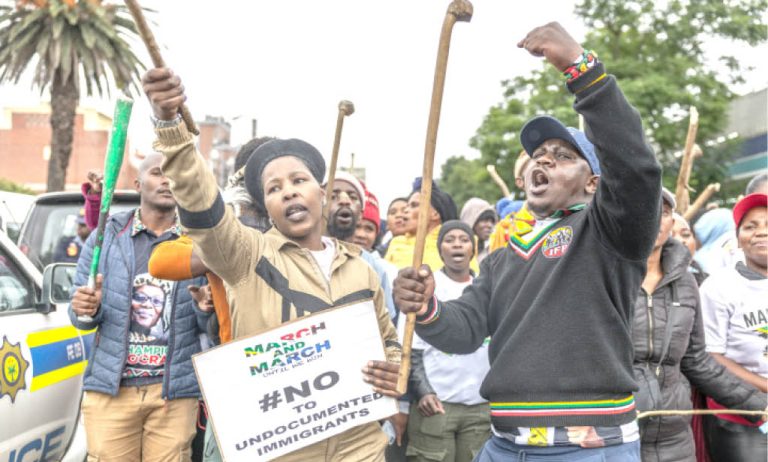
There is currently a growing anti-foreigner protest across South Africa, where demonstrators have targeted foreign-owned shops while calling for the expulsion of non-nationals.
A statement on Friday, signed by Abdur-Rahman Balogun, spokesperson for the Nigerians in Diaspora Commission (NiDCOM), asked Nigerians in South Africa to shut their businesses and stay safe.
He said the advisory followed a circular from the Nigerian consulate-general in Johannesburg on Wednesday.

According to the commission, protests in East London, Cape Town, Durban, and KwaZulu-Natal have turned violent, leading to looting, destruction of property, and injuries.
NiDCOM said intelligence from the consulate indicates that fresh protests are planned in Gauteng province between April 27 and 29, with demonstrators seeking to pressure the South African government over the presence of foreign nationals.

NiDCOM also urged Nigerian business owners to close their shops on April 27, marked as Freedom Day, and consider remaining closed on April 28 and 29, noting that foreign-owned businesses are often targeted during unrest.
However, many Nigerians have taken to social media to condemn the federal government’s lack of concrete action to protect its citizens in South Africa, adding that asking Nigerians to hide indoors was not the solution to the issue.

Ghana’s stand
Ghana, on the other hand, has reacted to a viral video of some of its citizens being harassed in South Africa by summoning South Africa’s acting High Commissioner to Accra, Thando Dalamba.
Ghana’s Ministry of Foreign Affairs said the victim in the viral video was a legal resident in South Africa and condemned the public harassment.
Ghana’s Minister of Foreign Affairs, Samuel Ablakwa, announced that the government would relocate the victim, Emmanuel Asamoa, at full cost after he faced threats and harassment.
The Ghanaian government also engaged South African authorities directly, leading to official apologies and diplomatic meetings.
Call for action
In the statement, the NICASA expressed deep concern and unequivocal condemnation of the rising wave of hate, xenophobic aggression, targeted harassment, and reported instances of police brutality against Nigerian citizens and other African nationals residing in South Africa.
Onyekwelu said, “We are alarmed by the increasing normalisation of hostility, manifested through inflammatory rhetoric by certain political actors, unlawful intimidation, and discriminatory enforcement practices by some law enforcement personnel.
“These actions not only undermine human dignity but also threaten the long-standing bonds of African solidarity.”
The group demanded an immediate high-level diplomatic engagement with South African authorities to ensure the protection of lives, businesses, and the rights of Nigerians.
It also called for a transparent mechanism for reporting, documenting, and addressing cases of abuse, harassment, and xenophobic violence.
In addition, the Nigerian group demanded clear accountability for any law enforcement officers found culpable in acts of brutality or discrimination.
Besides, it wants public reassurance from the Nigerian government, affirming its commitment to the safety and welfare of its citizens globally.
While noting that xenophobia is a direct contradiction of the vision of continental integration and shared prosperity, NICASA called for a united continental response through the African Union and regional blocs.
When contacted, Kimiebi Imomotimi Ebienfa, the spokesperson of Nigeria’s Ministry of Foreign Affairs, said the government was still waiting for an update from its missions in Pretoria and Johannesburg.
In a short WhatsApp message to Daily Trust, he said, “[We are] waiting for updates from our Missions in Pretoria and Johannesburg”.
Nigerian, S/African govts need to act decisively – Diplomats
Ambassador Martin Ihoeghian Uhomoibhi, a former President of the United Nations Human Rights Council, condemned the xenophobic attacks in South Africa, calling on the Nigerian government to act more decisively.
Ambassador Uhomoibhi, who also served as Permanent Secretary of the Nigerian Ministry of Foreign Affairs, said, “The Federal Government should take strict action.
“You cannot go to sleep when you are being publicly attacked. Nigeria should act and act very simply and promptly.”
He rejected the idea that Nigerians should leave South Africa for peace to reign, adding, “That is not the solution. You [Nigeria] should take diplomatic action.”
“The game of diplomacy is reciprocity. You slap me, I slap you back. In diplomacy. If you keep quiet, you portray yourself as a sleepy dog or something or a nobody.”
A former Nigerian ambassador to Sudan, Côte d’Ivoire and Angola, Suleiman Dahiru, has said Nigeria’s response to recurring xenophobic attacks in South Africa remains largely constrained to diplomacy, insisting that Abuja has little room for coercive action.
Speaking in a telephone interview with Daily Trust last night, Dahiru argued that while the attacks are “totally misplaced,” the responsibility for ending them rests squarely with the South African authorities.
“Nigeria has engaged South Africa on so many occasions. This is a diplomatic issue, and it is being handled diplomatically,” he said.
He dismissed suggestions that foreign nationals, including Nigerians, are responsible for job losses in South Africa, describing such claims as unfounded.
“They are not working for any state government in South Africa. They are not working for any local government. So, to blame them for taking away jobs that should normally go to them is totally wrong,” he said.
According to him, African migrants operate mostly in private businesses and should not be scapegoated. “Nobody has stopped South African blacks from doing what other Africans are doing. Let them set up their own businesses and get their own people to patronise them,” he added.