Remo Must Benefit From Industrial Boom, Tunde Lemo Tells Ogun Government, Investors


ABEOKUTA — A former Deputy Governor, Central Bank of Nigeria (CBN) and industrialist, Tunde Lemo, has called on the Ogun State Government and industrial investors to ensure that host communities in Remo benefit directly from the growing industrial and commercial activities in the arelemo
Lemo, who spoke as the guest speaker at the Sagamites Club investiture ceremony held on Saturday, October 10, 2026, proposed a new framework that would guarantee host communities a stake in businesses established on their land, prioritise local employment and enforce international environmental standards.
Delivering a paper titled “Sub-National Economic Hub as a Catalyst for National Economic Development: The Contributions of Remo to National Economic Development and the Challenges Ahead,” Lemo warned that communities hosting industrial development risk being excluded from its benefits if deliberate policies were not put in place to protect their economic interests.
He argued that while industrialisation was essential to economic growth, its benefits must translate into improved livelihoods, employment opportunities and sustainable development for the people whose land and environment support such investments.

“The community that hosts prosperity can be priced out of it,” Lemo warned, identifying rising living costs, environmental pollution, insecurity and the loss of ancestral land as major challenges confronting host communities.
He maintained that the development of Remo should not be viewed in isolation but as part of a broader strategy to strengthen Ogun State’s economy and contribute to Nigeria’s national economic development.

According to him, strong sub-national economic centres can generate employment, attract investments, stimulate surrounding communities, increase government revenue and connect local production to national and international markets.
Lemo noted that Nigeria’s overdependence on petroleum had weakened the contribution of other productive sectors and left many states excessively reliant on federally distributed revenues.

He recalled that Nigeria’s regional economies played significant roles in national development during the 1950s and 1960s through agriculture, exports and other productive activities before petroleum became the dominant source of foreign exchange and government revenue.
He said rebuilding strong state and regional economies would help diversify Nigeria’s economic base and reduce excessive dependence on the Federal Government.
On Remo’s economic prospects, Lemo identified its strategic location along major transportation corridors linking Lagos, Ibadan, the South-West and other parts of the country as a major advantage for industrialisation, logistics and commercial activities.
He described Sagamu and Iperu as important trade and manufacturing centres, noting that the area’s proximity to Lagos offered investors access to a large consumer market, financial institutions, international trade infrastructure and transportation networks.
He also identified limestone deposits, agricultural production and existing industrial activities as important components of the area’s economic potential.
The former CBN official called for the development of the Ogere trailer park into a dry port, supported by an effective direct rail connection, to help decongest the Apapa and Tin Can Island ports in Lagos.
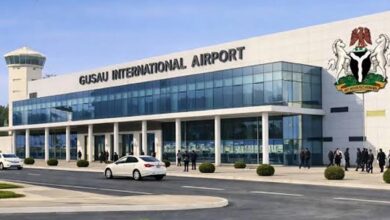
Lemo further highlighted the Gateway International Airport at Iperu-Remo and the proposed IPR Industrial Platform Remo Free Zone as developments capable of expanding the area’s industrial and commercial opportunities.
He said the planned free zone, described as covering approximately 5,000 hectares, could strengthen Remo’s connections to Lagos, the wider Nigerian market and West African economies.
On Ogun State’s economic performance, Lemo cited National Bureau of Statistics figures showing that the state’s internally generated revenue rose from approximately ₦5.35 billion in 2008 to ₦252.36 billion in 2025.
He said the growth demonstrated the increasing importance of internally generated revenue to the state’s fiscal capacity, while stressing that the next phase of development should focus on ensuring that communities hosting economic activities also experience tangible improvements in their standard of living.
To address the challenges associated with rapid industrialisation, Lemo proposed what he described as a “New Deal for Host Communities,” built around four key commitments.
He called for landowners whose properties were acquired for industrial development to retain a recognised stake in the businesses established on such land, including arrangements that would enable them to share in future profits.
He argued that such a framework would prevent host communities from losing the long-term economic value of their land without receiving commensurate benefits from the businesses operating on it.
Lemo cited the host-community trust framework under the Petroleum Industry Act as a precedent that could inform the development of a similar model for industrial communities.
He called for development master plans that would provide adequate space for the expansion of towns, villages and cities, warning that uncontrolled industrial growth could overwhelm existing settlements and infrastructure.
He called for strict compliance with international environmental, governance and sustainability standards to protect communities from the harmful effects of industrial pollution.
Lemo cited Ogijo as an example of the environmental risks associated with industrial activities, referring to the reported closure of seven used-lead-battery recycling plants following investigative reports and the subsequent commencement of a cleanup exercise.
He said stronger preventive measures and enforcement were necessary to protect the air, water and soil of host communities.
The speaker also identified rising living costs and insecurity as challenges that could undermine the social stability of communities experiencing rapid urbanisation.
Lemo urged the Remo elite, particularly members of the Sagamites Club, to take a more active role in attracting industries and investing in the development of their communities.
He called on the club to work with traditional institutions and government authorities to improve social amenities, promote vocational and technical training for young people, support reforms to land policies and ensure that businesses in the area observe environmental standards.
According to him, equipping local youths with employable skills would improve their chances of securing jobs in nearby factories while helping to reduce unemployment and its associated social problems.
He also challenged wealthy individuals and professionals from Remo to invest more of their resources in productive enterprises rather than concentrating predominantly on residential and religious buildings.
“Government cannot do it alone,” he said, urging members of the Sagamites Club to help attract more industries to Remo, particularly Sagamu, and support the transformation of rural settlements into well-developed urban centres through sustainable investments in social infrastructure.
Lemo commended the Sagamites Club for its contributions to community development since its establishment in 1972, describing its membership of business executives, public servants, corporate leaders and community figures as a valuable resource for the area’s development.
He stressed that the long-term prosperity of Remo would depend not merely on the presence of factories and major infrastructure projects but on the ability of its people to participate meaningfully in the economic opportunities being created.