L-I-F-E: Meet 67year-old Fish mongers Who Lost Three Fingers
…Says Trade Paid Her Children’s Way Through School

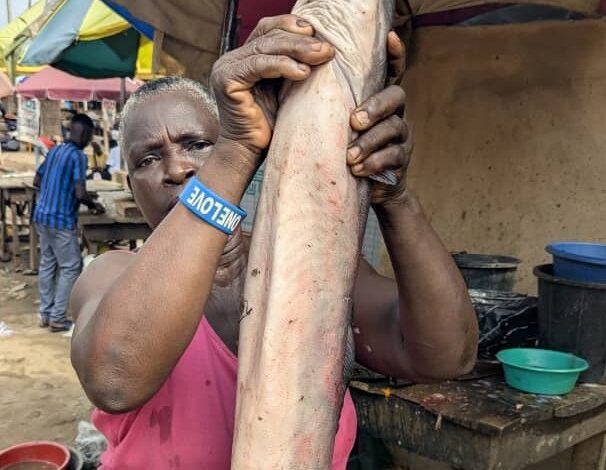
ABEOKUTA — At almost 67 years of age, Foluke Adeife has little to show for more than four decades spent in the fish market than the scars on her hands – the missing fingers on her right hand – and most importantly, the satisfaction of knowing that the trade she started as a young woman helped raise five children.
For Adeife, the unpredictability of the business is one of the realities women in the informal sector must contend with. But she has remained committed to the trade because it is what she knows and what has sustained her for decades.
For Adeife, fish mongering is more than a means of livelihood. It is the business that kept food on her family’s table, paid school fees and eventually helped one of her children build the house in which she now lives.
A native of Osun State and a member of a royal family in Ojurabesa compound, Ile-Ife, Adeife was born in Abeokuta and spent part of her childhood in Sokoto State, where she attended Sarkin Adam Primary School.
Her journey into the informal economy began with food vending at Olomore before she eventually settled into fish mongering.

“I have been working as a fish monger for over 30 years,” she said.
What began as a survival strategy gradually became a dependable source of income. Through the years, Adeife said she was able to use the proceeds from the trade to send all her five children to school.

“The work is very good because I have been able to send my children to school through this business. I have five children and one of them built the house I am living in, but the journey has not been without painful sacrifices,” she said.
One of the most traumatic moments of her career came while trying to cut a large fish. In a split second, the cutlass she was using slipped and landed on her hand, severing three of her fingers.

“There was a day I was injured with a cutlass. I wanted to cut a big fish and, as I was about to cut the fish, I mistakenly placed the cutlass on my hand and three of my fingers were cut off. Yet, the injury did not end my career,” she recalled.
With the same hands, now permanently marked by the accident, Adeife returned to the market and continued cutting fish to support herself and her family.
Her daily earnings, however, are never guaranteed.
Some days are rewarding, while others end without a single fish being sold.
“It depends on how fast the market sales are. Sometimes, when you make sales, you will be happy, and sometimes you will be sad if you don’t make sales,” she said.
On a good day, she can cut between 12 and 15 fish or even more. On a bad day, there may be nothing to sell.
“Sometimes I cut 12 to 15 fishes or more than that. Sometimes I don’t cut anything. It depends on the sales,” she explained.
She also believes the occupation is particularly suitable for women because it does not require the physical strength needed to butcher larger animals such as cattle or goat.
“Fish mongering is okay for females because a female’s strength cannot hold a cow. My strength can still hold the fish down and kill it, no matter how big it is,” she said.
She recalled that all her children were born while she lived in a rented apartment, at a time when she had to take whatever work was available to survive.
She said she had been in the fish business for more than 30 years, describing her entry into the trade as a product of circumstances and the influence of the person she was living with at the time.
Today, Adeife is looking beyond her personal survival. She wants government and political leaders to remember women like her whose livelihoods depend entirely on daily sales.
Rather than handouts, she wants support that can strengthen the businesses through which people like her have survived.
“We can use support. This fish work is all we know how to do instead of begging around for help,” she said, adding that she and others in the trade are also supporting Senator Solomon Adeola, popularly known as Yayi, while hoping that government will consider ways to assist them.
For a woman who has spent much of her life standing over a chopping board, cutting large fish with a cutlass and enduring the uncertainties of the market, Adeife’s definition of success is simple.
She has raised five children, educated them through a difficult trade and survived an accident that could have ended her working life.
The missing fingers on her hand may forever remind her of the dangers of the job, but they also tell another story, that of a woman who refused to surrender her livelihood to hardship.