You’re Not Eligible To Contest For Presidency In 2027, Oladele Tells Jonathan

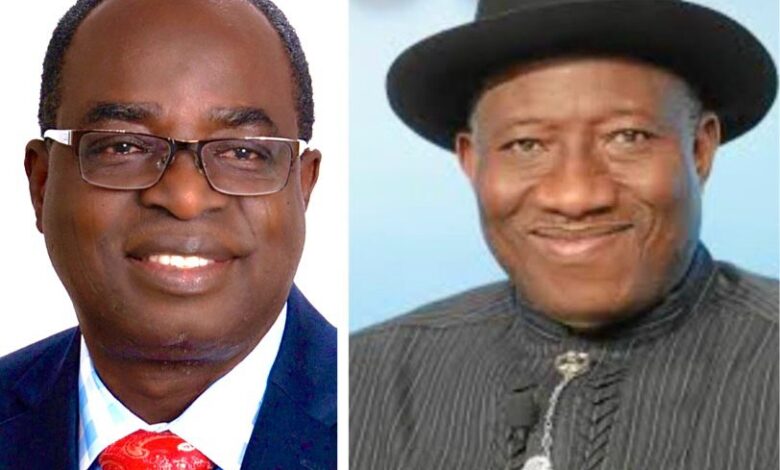
ABEOKUTA – A former Acting Executive Chairman of the Federal Character Commission and constitutional lawyer, Kayode Oladele, says no amount of consultation can reopen a presidential path for former president, Goodluck Jonathan.
Jonathan, while addressing youth groups in Abuja who urged him to return to the presidential race, acknowledged their appeals and pledged to reflect before taking any political step.
“I’ve heard you loud and clear. I will consult widely before taking any decision,” the former president said.
But according to Oladele, while consultation is a legitimate political exercise, constitutional qualification is a legal matter, and in Jonathan’s case, the legal boundaries are already firmly established.
Oladele argued that the excitement surrounding Jonathan’s possible return may be emotionally appealing to some elements, especially those who remember him with nostalgia but constitutional democracy cannot operate on sentiment, public pressure, or political longing.

He maintained that the decisive issue is not whether Jonathan is popular, experienced, or nationally acceptable, but whether the constitution permits him to contest again.
“At the level of politics, anyone can be encouraged to consult,” Oladele said.

“But at the level of constitutional law, eligibility is not determined by applause, youth endorsement, or political strategy. It is determined strictly by the provisions of the Constitution, and those provisions are very clear.”
Oladele’s position rests squarely on Section 137(3) of the 1999 Constitution, inserted through the Fourth Alteration Act No. 16 of 2018, which provides that any person who assumes the office of president to complete the tenure for which another person was elected shall not thereafter be elected to that office more than once.

He explained that this provision was not inserted casually. Rather, it was a deliberate constitutional safeguard designed to close what lawmakers considered a dangerous loophole in Nigeria’s presidential tenure framework.
He stressed further that, before the amendment, the constitution barred any person from being elected president more than twice, but it did not sufficiently address the unique circumstance of a vice president or successor inheriting office midterm and then seeking two additional full terms.
According to Oladele, this omission created the possibility that an unelected successor could potentially remain in power for close to a decade, thereby undermining the spirit of the two term principle.
“The amendment was a corrective constitutional intervention,” Oladele said.
“It was specifically designed to ensure that succession by accident or constitutional necessity does not become a route to excessive incumbency.”
He noted that Jonathan’s rise to power in May 2010 after the death of President Umaru Musa Yar’Adua placed him directly within the category contemplated by Section 137(3).
By completing Yar’Adua’s unexpired tenure from 2010 to 2011 and then contesting and winning the 2011 election, Jonathan, in Oladele’s interpretation, fully utilized the single additional electoral opportunity permitted to a successor president.
“Former President Jonathan is not being singled out unfairly,” Oladele said.
“He simply happens to be the most prominent real world example of the constitutional scenario that the Constitutional amendment sought to regulate.”
Oladele further rejected arguments from some Jonathan supporters that applying the 2018 amendment to him would amount to retroactive legislation.
He explained that Section 137(3) does not invalidate Jonathan’s prior service or penalize him for actions lawfully taken before the amendment. Instead, it prospectively defines future eligibility criteria.
In his view, there is a major legal distinction between retroactively punishing past conduct and prospectively regulating qualifications for future office.
“The Constitution is not punishing Jonathan for having served,” he said.
“It is simply saying that going forward, anyone who has completed another president’s tenure and then secured one elected term has exhausted the constitutional allowance.”
Oladele also drew support from broader constitutional philosophy and judicial precedent, citing Nigeria’s Supreme Court stance in tenure related cases such as PDP v. Sylva, where the court emphasized that constitutional term limits are structural protections, not technical inconveniences to be manipulated.
He said term limits are central to democratic predictability because they protect against tenure elongation, preserve political balance, and reassure citizens that leadership rotation is governed by law rather than personal ambition.
According to him, Nigeria’s democratic history, shaped by past struggles against authoritarianism and tenure manipulation, makes fidelity to constitutional limits especially important.
“Our democracy is strengthened not when powerful individuals test the edges of constitutional silence,” Oladele said, “but when the nation respects the discipline of constitutional clarity.”
He also compared Nigeria’s framework to the United States’ Twenty-Second Amendment, noting that mature presidential systems deliberately prevent successors from converting extraordinary entry into prolonged control of executive power.
For Oladele, the principle is universal: executive authority must remain temporary, predictable, and constitutionally restrained.
He warned that any political party seeking to draft Jonathan for 2027 despite the constitutional hurdle would risk legal uncertainty, reputational damage, and possible electoral catastrophe.
Such a move, he said, could trigger immediate constitutional challenges, distract from substantive campaigning, and potentially invalidate candidacy efforts before or after nomination.
“Political parties must distinguish between emotional mobilization and constitutional viability,” he said.
“A candidacy that begins under a cloud of constitutional disqualification is a dangerous gamble.”
While Oladele acknowledged Jonathan’s continuing stature as a respected statesman with every right to contribute to national discourse, democratic advocacy, and political consultation, he insisted that those rights do not automatically translate into eligibility for every office.
“Former President Jonathan remains free to consult, to speak, to lead conversations, and to shape national debate,” Oladele said.
“But consultation is not candidacy, and influence is not eligibility.”
He concluded that the recurring public conversation around Jonathan’s possible return may continue as political theatre, but from a legal perspective, the issue is substantially settled.
“The Constitution anticipated this very scenario and addressed it,” he said.
“So while consultation may keep the political conversation alive, constitutional law has already drawn the line. Nigeria’s democracy can only mature when constitutional boundaries are respected not only when convenient, but especially when inconvenient.”